
Decision Velocity When AI Skills Are Present and Uneven
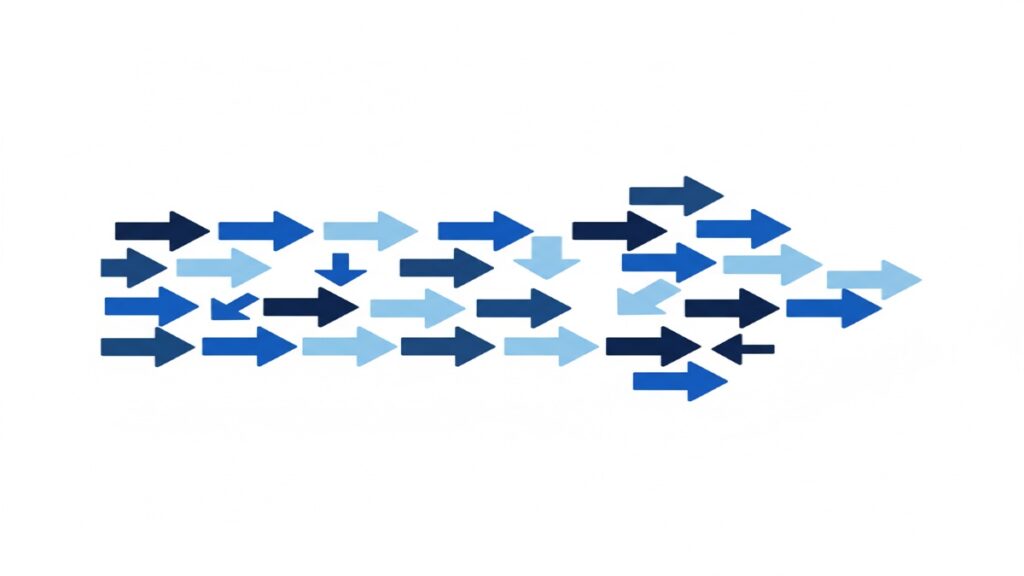
Sarah’s CTO walked into the quarterly planning meeting with a 14-page analysis. Market trends, competitive positioning, three scenario models, a recommended path forward. He had built it in two hours using AI tools his team had been running for months.
The four VPs sitting across the table had nothing comparable. Not because they lacked intelligence or work ethic. Because they lacked fluency. They spent the next 90 minutes asking clarification questions, challenging assumptions they did not have the tools to verify independently, and requesting a follow-up meeting to “process the data.”
That follow-up meeting happened two weeks later. By then, the window on one of the three scenarios had closed.
Case Study: Sarah, CEO, 280-Person Enterprise Software Company
Sarah’s CTO presented a 14-page AI-generated analysis at the quarterly planning meeting. The four other VPs had nothing comparable — not because they lacked intelligence, but because they lacked AI fluency. They spent 90 minutes asking clarification questions and requested a follow-up meeting.
The cost: The follow-up happened two weeks later. By then, the window on one of three strategic scenarios had closed entirely. As Sarah put it: “I thought AI would make us faster. Instead, it made us lopsided.”
AI Does Not Slow Decisions. Uneven AI Fluency Does.
Gartner created its first Magic Quadrant for Decision Intelligence Platforms in 2026. The entire category assumes that better data tools produce better decisions. And they can — when everyone at the table knows how to use them.
But here is what the Decision Intelligence category misses: it targets CIOs and data teams. It assumes the bottleneck is information quality. In my experience working with 125+ leadership teams at companies between $10M and $50M, the bottleneck is almost never information quality. It is alignment speed.
McKinsey found that only 28% of executives say decision-making at their organization is effective. Companies with fast decision-making are twice as likely to report above-average financial results. These numbers have not changed much in a decade. And adding AI tools to a leadership team with uneven fluency makes the gap worse, not better.
Alignment Tax — the invisible overhead your company pays every time a decision gets rerouted, a meeting runs without an outcome, or a priority gets reinterpreted on its way down the org chart. In a typical company between 100 and 500 employees, that tax runs $280K to $420K annually in visible costs alone: meeting overhead, rework, delayed execution.
Now add an AI fluency gap to the mix, and you get a new line item on top of the existing tax.
The Translation Tax: A New Layer on the Alignment Tax
Translation Tax — the cost of translating AI-generated insight into a form the rest of the leadership team can evaluate. This tax did not exist two years ago and emerges whenever one leader becomes AI-fluent while the rest of the team cannot independently pressure-test AI-assisted analysis.
Here is what I see playing out in company after company:
One leader becomes AI-fluent. Usually the CTO or a technically oriented VP. They start producing faster analysis, sharper recommendations, more data-rich proposals.
The rest of the team cannot keep pace. Not because the analysis is wrong. Because they have no independent way to pressure-test it. They rely on the AI-fluent leader to explain, simplify, and defend — which takes longer than the old way of everyone arriving with comparable (if slower) preparation.
Decision velocity drops. The information-gathering phase compresses for one person and expands for everyone else. The alignment phase — where the team needs shared understanding before committing — actually gets longer.
USAII reports that 89% of leadership teams lack basic AI literacy. Bain found that executives at companies between 100 and 500 employees spend 30 to 40 percent of their time on coordination rather than strategy. When one leader operates at a different speed than the rest, coordination time increases. The team spends more hours reconciling different levels of analysis quality instead of debating strategic direction.
This is not a technology problem. It is a decision infrastructure problem.
Three Decision Infrastructure Changes That Close the Gap
When I work with leadership teams facing this dynamic, I focus on infrastructure, not training. Teaching everyone to use ChatGPT does not solve the underlying issue. These three changes do.
1. Establish a Decision Rights Map for AI-Informed Recommendations
Decision Rights Map — an explicit document that answers three questions for every recurring decision: Who owns it? At what threshold does it escalate? Who needs to know the outcome? When AI enters the picture, a fourth question is required: What standard of evidence does an AI-assisted recommendation need to meet before the team acts on it?
Sarah’s team added a simple rule: any AI-generated analysis presented in a leadership meeting must include the prompt used, the data sources referenced, and a one-paragraph summary a non-technical leader could evaluate independently. This did not slow the CTO down. It gave the other VPs a foothold for informed disagreement — which is what productive decision-making actually requires.
2. Separate the Information Phase from the Alignment Phase
Most leadership meetings collapse these two phases into one conversation. Someone presents data, and the team tries to align on a response simultaneously. When AI compresses the information phase for one person, this collapse becomes destructive.
The fix is structural. Distribute AI-assisted analysis 48 hours before the decision meeting. Use that buffer for VPs to review, ask questions asynchronously, and arrive with positions rather than reactions. The meeting itself becomes an alignment conversation, not a presentation followed by confusion.
Case Study: COO, 190-Person Fintech Company
A COO at a 190-person fintech company implemented the structural separation of information and alignment phases for all leadership meetings. AI-assisted analysis was distributed 48 hours before decision meetings, giving VPs time to review and arrive with positions rather than reactions.
The fix: This single change cut their average decision cycle from 11 days to 4 — not because the AI was faster, but because the humans had time to catch up.
3. Create an AI Fluency Baseline Across the Leadership Team
This is not about making every VP a power user. It is about ensuring every leader can independently evaluate AI-assisted work product. The baseline I recommend has three components:
- Prompt literacy: Can this leader read an AI prompt and understand what it asked for and what it excluded?
- Output skepticism: Can this leader identify when an AI-generated analysis contains assumptions that need verification?
- Tool parity: Does every leader on the team have access to the same AI tools, even if they use them at different levels of sophistication?
When the baseline exists, the translation tax drops. Leaders stop needing the AI-fluent person to interpret results. They start asking better questions, faster.
The Real Bottleneck Is Not Speed. It Is Shared Readiness.
AI compresses the information-gathering phase of decisions. That is real and valuable. But decision velocity is not defined by how fast one person can gather information. It is defined by how fast the team can move from information to aligned action.
When AI skills are present but uneven, you get the worst of both worlds: one leader who is ready to act and four who are not. The result is not faster decisions. It is faster frustration.
The companies I see navigating this well are not the ones with the most advanced AI tools. They are the ones who build decision infrastructure that accounts for uneven fluency. They treat AI readiness as an alignment problem, not a training problem.
| Change | What It Solves | Implementation | Expected Outcome |
|---|---|---|---|
| Decision Rights Map | AI recommendations bypass team evaluation | Add a 4th question: What evidence standard must AI-assisted analysis meet? | Every VP has a foothold for informed disagreement |
| Separate Information from Alignment | Meetings collapse data presentation and decision-making | Distribute AI analysis 48 hours before decision meetings | Decision cycles drop from 11 days to 4 |
| AI Fluency Baseline | Translation Tax — one leader interprets AI for everyone | Build prompt literacy, output skepticism, and tool parity across the team | Leaders independently evaluate AI work product |
If you are not sure where the bottleneck lives in your own leadership team — whether it is decision rights, alignment speed, AI fluency gaps, or something else entirely — that is exactly what the Executive Escalation Assessment measures. It takes about 12 minutes and identifies the specific friction points dragging your team’s decision velocity.
Related Articles
- The Alignment Tax is Unforgiving — The hidden cost AI reveals at speed
- AI Fluency for Leadership Teams — The 4 levels of team AI fluency that determine your decision speed
- Agent Managers at 200 People — When AI agents join your org chart, decision rights need updating
- Beyond 1:1 Coaching — Building the collective capability that closes the fluency gap