
The Alignment Tax: Why Growing Companies Slow Down
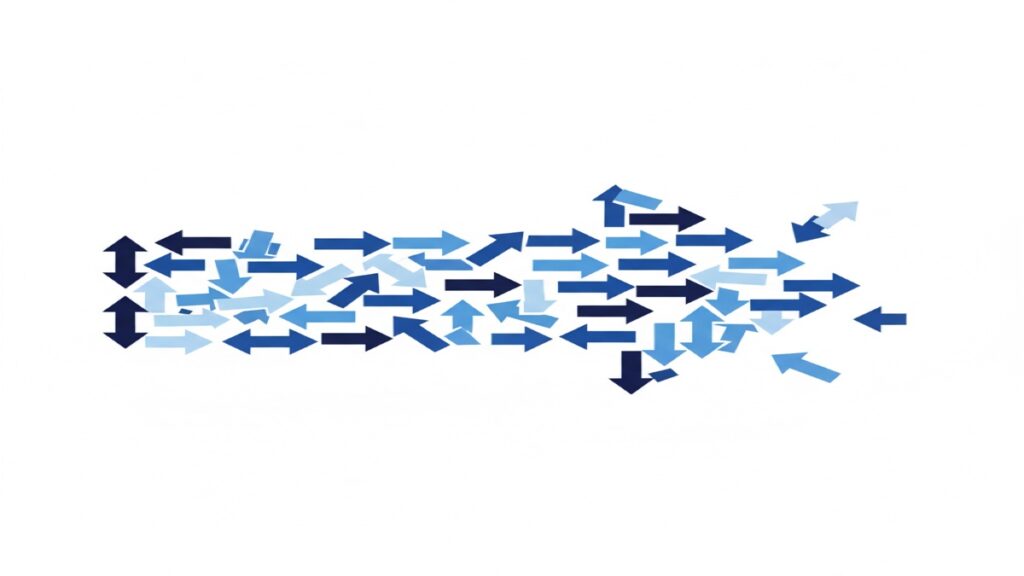
You doubled headcount. Decision velocity dropped by 75%. Welcome to the Alignment Tax—the hidden cost that growing companies pay when informal coordination breaks down faster than formal systems can replace it.
What Is the Alignment Tax?
The Alignment Tax is the cumulative cost organizations pay when team members work at cross-purposes, duplicate efforts, wait for clarification, or undo work that shouldn’t have happened in the first place. It’s the difference between what a company could produce with perfect coordination and what it actually produces given real-world friction.
At 30 employees, alignment happens organically. Everyone knows everyone. Context travels through hallway conversations. Decision rights are understood implicitly. The CEO can hold the whole picture in their head.
At 150 employees, none of that works anymore. The infrastructure that made coordination effortless has collapsed, but most companies haven’t built the formal systems to replace it. That gap is where the Alignment Tax lives.
The Math Behind the Slowdown
Communication complexity grows exponentially with headcount. A 5-person team has 10 potential communication paths. A 50-person team has 1,225. A 150-person team has 11,175.
But the Alignment Tax isn’t just about communication volume—it’s about the quality of coordination. Here’s where typical growing companies lose ground:
- Decision delays: When it’s unclear who can approve what, requests queue up. A decision that took 2 hours at 30 employees takes 2 weeks at 150.
- Rework cycles: Teams build what they think was requested, only to discover mid-project that stakeholders had different expectations. Average rework rate in misaligned organizations: 23% of engineering capacity.
- Meeting overhead: Without clear decision rights, meetings multiply. “Quick syncs” proliferate because no one’s confident they have enough context to act autonomously.
- Talent drain: High performers leave environments where they spend more time navigating politics than building products. The Alignment Tax drives away exactly the people you need most.
The Infrastructure Gap
Most companies between 30 and 150 employees operate in what we call the “infrastructure gap”—the period where old coordination methods have failed but new ones haven’t been installed.
The gap manifests as:
- Implicit decision rights: “I’m not sure if this needs CEO approval or if I can just do it.”
- Undefined escalation paths: “When should I bring this up, and to whom?”
- Competing priorities: “Product says X is urgent. Engineering says Y. Which wins?”
- Context loss: “Why was this decision made? What constraints were they working with?”
Each of these ambiguities costs time. Multiply by the number of decisions made daily, and you’ve found the source of your deceleration.
Quantifying Your Alignment Tax
Most leadership teams underestimate their Alignment Tax by 3-5x. Here’s a diagnostic exercise:
Track for one week:
- How many times did someone wait for clarification before proceeding?
- How many decisions required meetings that could have been emails?
- How many projects experienced scope change due to stakeholder misalignment?
- How many hours did executives spend on issues that should have been resolved at lower levels?
Assign dollar values (average salary ÷ 2080 hours × time spent). The number will be uncomfortable. That’s the point.
Reducing the Tax
The Alignment Tax can’t be eliminated—some coordination cost is inherent to collaborative work. But it can be reduced dramatically through intentional infrastructure:
- Explicit decision rights: Document who can decide what. Make it searchable. Update it quarterly.
- Defined escalation thresholds: Create clear criteria for when issues need to move up. “Escalate if: impact exceeds $X, timeline shifts by Y days, or cross-functional conflict can’t be resolved in one meeting.”
- Priority arbitration protocols: Establish processes for resolving competing priorities before they reach the executive team.
- Context documentation: Record not just decisions but the reasoning behind them. Future you will thank present you.
Companies that address the infrastructure gap typically recover 15-25% of engineering capacity within one quarter—capacity that was being consumed by the Alignment Tax.
The Bottom Line
Every growing company pays the Alignment Tax. The question is whether you pay it consciously, through intentional infrastructure investment, or unconsciously, through decision delays, rework, and attrition.
High-performing leadership teams don’t avoid alignment challenges—they build systems to address them before they compound. The companies that scale successfully aren’t the ones that got lucky with alignment. They’re the ones that took it seriously.
Assess Your Alignment Tax
Want to quantify how much misalignment is costing your organization? The Executive Escalation Audit reveals where decision-making breaks down and what it’s costing in real dollars. Take the free assessment →