
Decision Velocity: Why Projects That Should Take 2 Weeks Are Taking 6
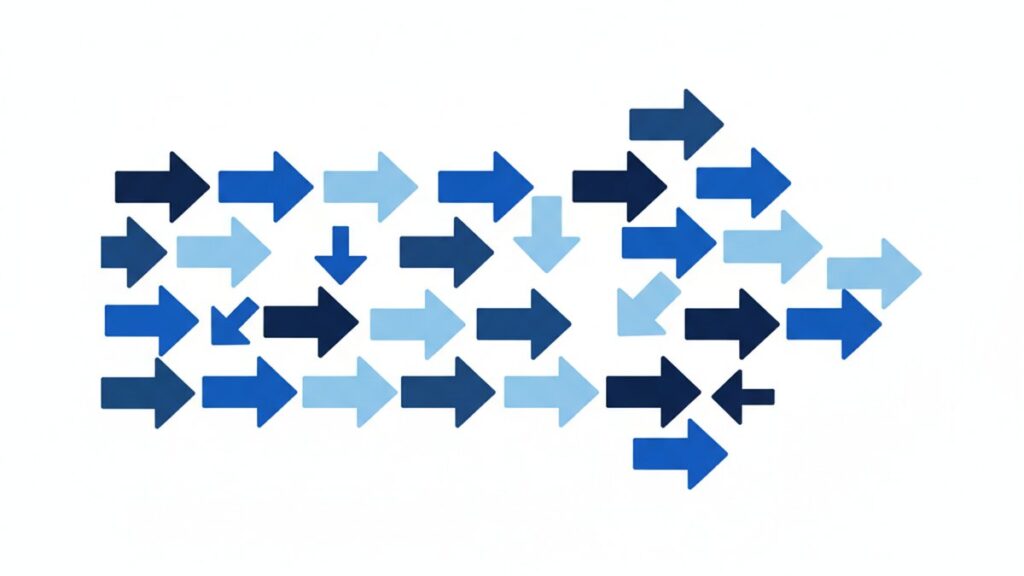
Your calendar shows back-to-back meetings. Your inbox has 50+ unread messages—most of them people waiting for your answer. That project you greenlit three weeks ago? Still sitting in limbo because it needs your approval to move to the next phase.
And somewhere in the back of your mind, you know this is unsustainable. But you tell yourself it’s just part of the job at your level.
It’s not.
What you’re experiencing is a decision velocity problem. And it’s costing you more than you realize.
The Decision Bottleneck Tax
When you’re the single point of approval for every significant decision, three things happen simultaneously:
First, everything slows down. Projects that should take two weeks stretch to six. Not because the work is hard, but because everything queues up waiting for you. Your team can’t move forward until you weigh in, and you’re triple-booked until Thursday.
Second, your team stops thinking. When people know they need your approval anyway, they stop evaluating options themselves. They don’t want to “make the wrong decision,” so they wait for you to decide. What started as healthy risk management becomes learned helplessness.
Third, you become the ceiling. Your organization can only move as fast as you can make decisions. Your team can only be as strategic as the decisions you have time to consider. Growth doesn’t just slow—it caps out at your personal capacity.
The math is brutal: If you can make 10 good decisions per day, and you have 30 decisions waiting, you’ve just created a 3-day delay for everyone downstream. Multiply that across every project, every week, and you see why that 2-week project is now in week 6.
Why Smart Leaders Accept the Bottleneck
Here’s what makes this problem insidious: it feels responsible.
You’re not hoarding decisions because you’re a control freak. You’re doing it because:
- You have more context than anyone else on your team
- The decisions genuinely matter—getting them wrong has real consequences
- Your team hasn’t demonstrated they can handle this level of complexity yet
- Last time you delegated something important, it didn’t go well
- You’re accountable for the outcomes, so you feel you should make the call
All of this is rational. All of it is understandable.
And all of it is keeping your team—and your career—stuck.
Because while you’re protecting the organization from bad decisions, you’re also preventing your team from developing the judgment to make good ones.
The Delegation Delusion
Most leaders think they’re already delegating. They assign tasks, distribute work, and expect their team to execute.
But there’s a massive difference between task delegation and decision delegation.
Task delegation sounds like:
- “Can you pull together the Q4 numbers for me?”
- “Please schedule the client meeting”
- “Update the status report and send it my way”
These are important. They free up your time. But they don’t develop your team’s decision-making capability.
Decision delegation sounds like:
- “Evaluate our three vendor options and recommend which one we should go with”
- “Design the onboarding process for our next engineering hire”
- “Determine how we should restructure the sprint process and present it to the team”
The difference? The second type creates an asset and requires judgment.
And here’s the problem: most leaders only delegate tasks. The meaningful work—the work that requires thinking, involves multiple stakeholders, and creates lasting value—stays with you.
Your team gets the grunt work. You get the bottleneck.
The 3-Level Delegation Model
Not all work should be delegated the same way. The reason most delegation fails is because leaders treat a 2-hour task the same as a 2-week project.
Here’s a more effective framework:
Level 1: Task Assignments (Hours)
Simple, clear-cut work that can be completed quickly. “Pull the metrics.” “Schedule the meeting.” “Update the document.”
Delegate freely. These should rarely come back to you.
Level 2: Structured Assignments (Days)
Work that requires some judgment but has clear parameters. “Research these three options and summarize the pros/cons.” “Draft the announcement email for my review.”
Delegate with checkpoints. Brief them clearly, check in midway, review the output.
Level 3: Delegation Assignments (Weeks)
This is where the magic happens. These are real projects that:
- Involve multiple people (cross-functional collaboration)
- Create an asset or support a decision with lasting impact
- Take 2 days to 4 weeks to complete
Examples:
- “Lead the evaluation of our project management tools and recommend what we should standardize on”
- “Design our customer feedback process and get buy-in from Sales and Support”
- “Analyze our sprint retrospective data and propose how we should restructure our agile process”
This is the work that’s currently sitting on your plate. The work that’s bottlenecking everything.
And it’s also the work that will transform your team.
Why Level 3 Delegation Changes Everything
When you delegate a real assignment—not just a task—multiple things happen:
Your team members develop new skills. They’re not just executing your decisions; they’re learning to evaluate options, weigh tradeoffs, and build conviction in their recommendations. These are the skills that prepare them for the next level.
They expand their network. Level 3 assignments require collaboration across teams. Your senior engineer talks to the product team. Your product manager interviews customers. These relationships compound over time and make your organization more connected.
They gain visibility. When someone leads a cross-functional project, they’re no longer just “Sarah from Engineering.” They’re “Sarah who redesigned our deployment process.” That visibility accelerates careers.
The work gets better. The person closest to the problem often has better insight than you do. When you delegate the analysis and recommendation (not just the execution), you get solutions you wouldn’t have thought of yourself.
And you get your time back. Not just 30 minutes here and there—6 to 10 hours per week. Enough time to actually think strategically instead of just reacting to the next fire.
The Decision Velocity Shift
Here’s what changes when you implement Level 3 delegation:
Week 1: You identify three projects currently on your plate that meet the criteria (multi-person, creates an asset, 2 days to 4 weeks). You assign them to three team members with clear outcomes and boundaries.
Week 2: Instead of making 10 decisions per day, you’re making 5—and reviewing 3 recommendations from your team. Projects start moving faster because people aren’t waiting for you.
Week 3: Your team members start coming to you with solutions, not just problems. “Here’s what I’m thinking—does this align with your vision?” instead of “What should I do?”
Week 4: That project that was stuck for 6 weeks? It shipped. Your calendar has white space. Someone on your team just had a breakthrough conversation with a stakeholder you didn’t even know they needed to talk to.
This isn’t theoretical. This is what happens when you shift from being the decision-maker to being the decision architect—someone who designs how decisions get made, not someone who makes every decision themselves.
The Real Obstacle
You might be thinking: “This sounds great, but my team isn’t ready for this level of responsibility.”
Here’s the hard truth: they’ll never be ready if you don’t give them the opportunity.
Delegation isn’t about waiting until someone is fully capable. It’s about creating the conditions for capability to develop.
You don’t need perfect people. You need:
- Clear assignment structure (what success looks like, what the boundaries are)
- Checkpoints (not micromanagement—strategic moments to course-correct)
- Permission to learn (they’ll make different decisions than you would, and that’s okay)
The leaders who break through the decision bottleneck aren’t the ones with the most talented teams. They’re the ones who build talent by delegating real work.
The Compounding Effect
Here’s what most leaders miss: decision velocity compounds.
When you delegate one Level 3 assignment, you free up time and develop one person.
When you delegate three, you create a team culture where people expect to own meaningful work.
When you do this consistently for 6 months, you’ve built a team that:
- Solves problems you don’t even know about yet
- Makes good decisions without you in the room
- Moves fast because they’re not waiting for permission
- Develops future leaders instead of permanent executors
Your role shifts from “person who makes all the decisions” to “person who ensures good decisions get made.”
That’s not abdication. That’s leadership.
Your Next Two Weeks
You have two choices:
Choice 1: Keep doing what you’re doing. Stay in every decision. Protect your team from complexity. Accept that projects will take 3x longer than they should, your calendar will stay packed, and your team will keep coming to you for answers.
Choice 2: Identify three real projects this week. Delegate them as Level 3 assignments. Coach your team through the process. See what happens when you shift from decision-maker to decision architect.
The second choice is uncomfortable. Your team will make different decisions than you would. Some will need more coaching than you expected. You’ll have to resist the urge to jump in and “fix it.”
But two weeks from now, you’ll have:
- Three completed projects
- Three team members with expanded capabilities
- 6-10 hours back in your week
- Proof that your team can handle more than you thought
And six months from now, you’ll have an entirely different team.
Ready to build a team that moves fast without you being the bottleneck?
The Lead Better sprint teaches tech leaders how to implement the 3-Level Delegation Model in just 2 weeks—with live coaching, real projects from your work, and a cohort of peers solving the same challenges.
Or if you’re not sure where your biggest bottlenecks are, start with our free Executive Escalation Assessment—it’ll show you exactly where decisions are getting stuck and what to fix first.